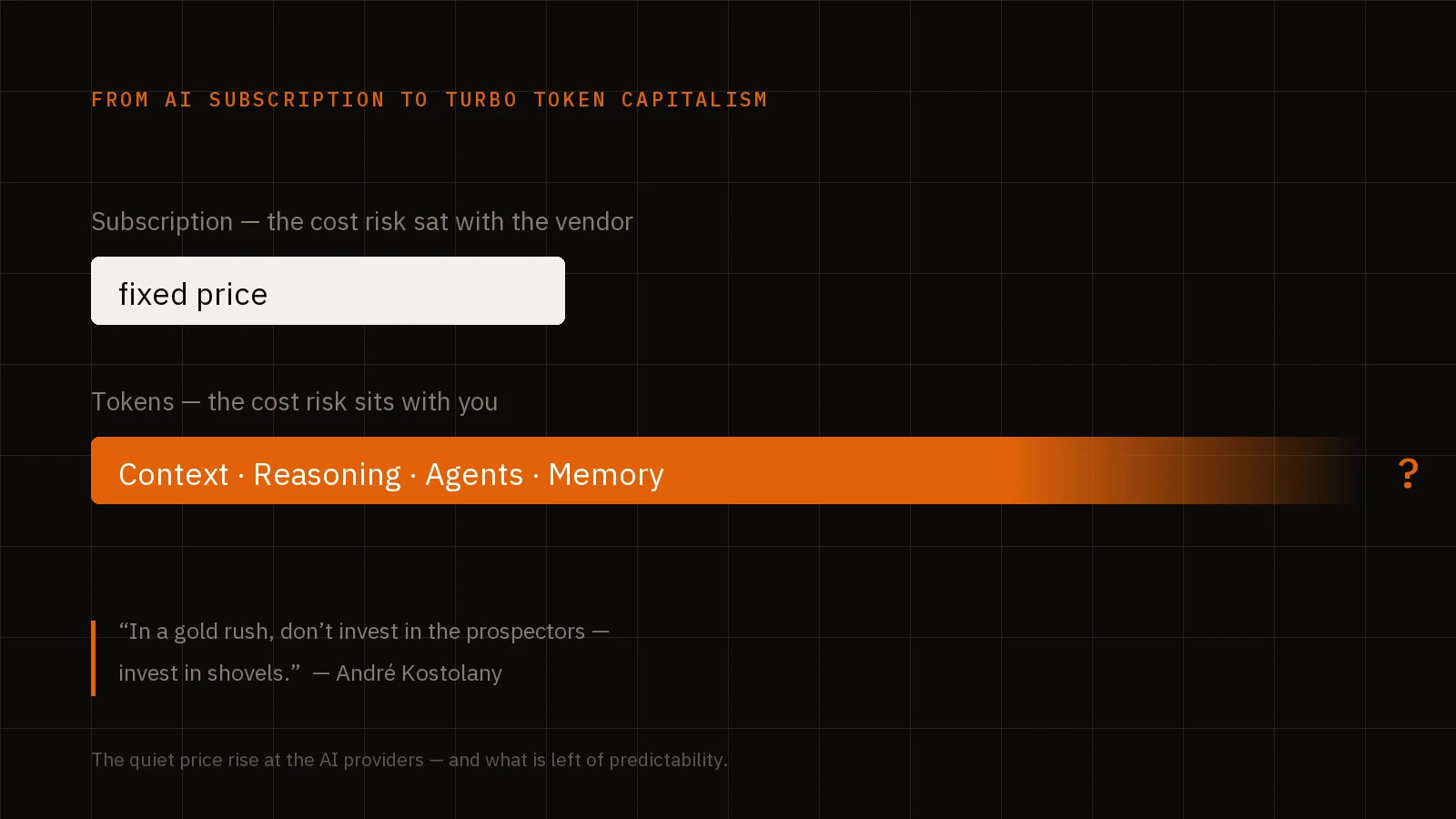
"In a gold rush, don't invest in the prospectors — invest in shovels." — André Kostolany
It happened faster than expected. Not long ago the world of large language models was simple: one subscription, one price, unlimited use. For companies, developers and startups that meant, above all, predictability. It began in 2025; by 2026 everything had changed.
The shift crept in: away from subscriptions, towards token-based billing. Subscriptions still cover simple work — but there we pay with our data as well.
Use more, pay more — sounds fair
The argument is persuasive, which is exactly why it works. But it moves the risk from the vendor to the user. Today we no longer know what a project will cost: volatile infrastructure costs, a constant stream of hyper-capable new models that can do everything — and that mostly seem to cost a great deal more. That is not optimisation. It is a planned shift of the price burden.
Token models only reveal their effect in production:
- Applications grow, and costs grow with them. Prompts get longer, context windows get larger.
- Reasoning overhead. Models "think longer", correct themselves, think again — consuming enormous amounts of tokens along the way.
- RAG, multi-agent and memory systems multiply consumption in the background, invisibly to the user.
What the subscription used to cover has become an open-ended cost centre. Complaints about exploding bills, and about successor models that feel less capable than their predecessors, are piling up — without performance improving proportionally.
Why this hits business models
Calculations rest on stable API costs and predictable margins. Remove that foundation and, in the worst case, margins collapse, prices become untenable and products have to be rebuilt. I know developers who cannot work by the middle of the month because their allowance is used up.
Why now, and why so fast?
Flat rates, war and rising usage have driven costs up. A substantial share of the data centres planned in the US has been postponed or shelved. And investors want to finally see a return.
So what now?
One path: accept the prices, narrow down to a single model, pass the budget on to clients — and put private projects on ice.
The other path, which does not rule out the first — and which is part of a larger movement, see digital sovereignty: buy your own machines, join forces with developers and users, form cooperatives, train smaller models. And if the answers then take longer: lean back, talk to your colleagues, and let it all sink in for a moment.
With apologies to Kostolany: let us make the shovels ourselves. We still have the choice.