Digital sovereignty has gone from niche topic to buzzword in a very short time — and buzzwords wear out before they change anything. This piece therefore attempts the opposite of alarmism: it collects what can be evidenced. Court rulings, internal corporate documents, parliamentary records, studies. And it states honestly where the European alternatives are strong today and where they are not yet.
What digital sovereignty means — and what it does not
The definition: the ability of states, companies and citizens to shape, control and — if necessary — replace their digital infrastructure, data and technologies on their own terms.
Put shortly: whoever can pull the plug holds the power.
Three dimensions are at stake. Data: who has access, whose law applies? Technology: who controls software, cloud, AI? Economy: where do money and value creation flow?
Sovereignty means freedom of choice and realistic options to switch, open standards and interoperability, negotiating as equals rather than as supplicants.
Sovereignty explicitly does not mean isolation or protectionism, nor abandoning international cooperation, nor having to build everything yourself. It means being able to replace.
Dependency in numbers
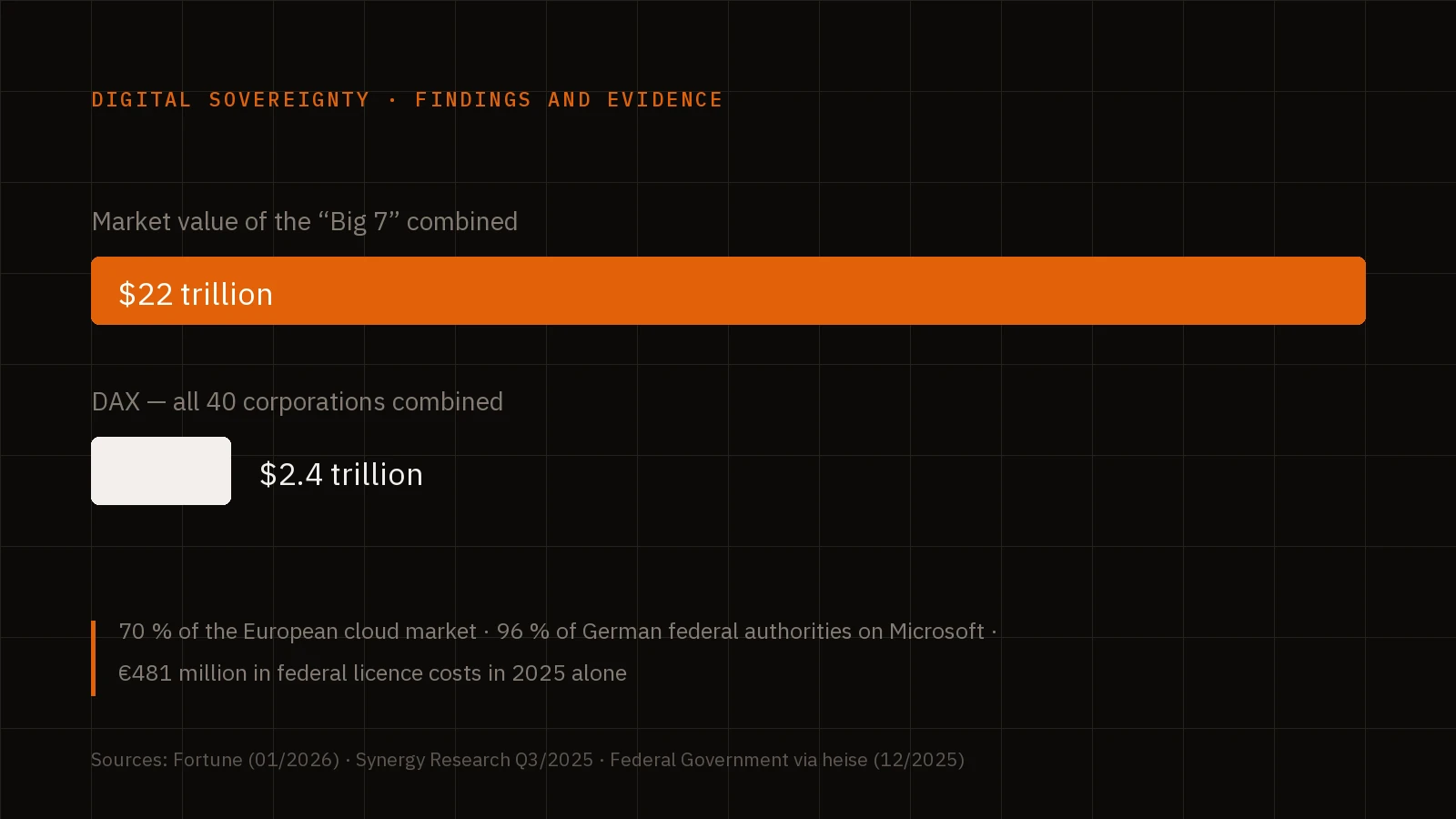
The "Magnificent Seven" — Microsoft, Apple, Nvidia, Alphabet, Amazon, Meta, Tesla — are together worth around $22 trillion. All 40 DAX corporations combined come to roughly $2.4 trillion. ASML stands at 718 billion, SAP at 180. Seven companies are therefore worth about nine to ten times the entire German blue-chip index.
Three figures on the European situation:
- ~70 % of the European cloud market is held by AWS, Microsoft and Google. European providers hold about 15 %.
- 96 % of German federal authorities run on Microsoft Office and Windows.
- €481 million was paid by the German federal government for Microsoft licences in 2025 alone — in 2023 it was still €274 million.
Sources: Fortune (01/2026), companiesmarketcap.com · Synergy Research Q3/2025 · PwC market analysis for the BMI (2019) · Federal Government reply to a Green Party enquiry, via heise (12/2025)
Four reasons every euro spent on Big Tech weakens Europe
1. Outflow of money and value creation. Billions in licence, cloud and advertising revenue flow to the US every year — and finance the next generation of dependencies there. The German federal government alone: around €1.9 billion for Microsoft licences since 2017.
2. Legal conflict instead of data protection. The US CLOUD Act obliges US providers to hand over data regardless of where the servers stand. That collides head-on with Art. 48 GDPR. No US provider can guarantee GDPR compliance.
3. Exposure to coercion and geopolitics. Whoever rents critical infrastructure can be sanctioned. US policy reaches into European authorities, companies and courts at the push of a button.
4. Damage to democracy. Platforms concentrate the power to shape opinion, amplify polarisation, and have demonstrably been misused to influence elections.
The pattern: first cheap, then unavoidable, then expensive
The approach is not a conspiracy theory but documented strategy — you can read it in Reid Hoffman's own words.
Phase 1 — predatory pricing. Losses subsidised by venture capital: offer services below cost, attract users and merchants, push out competitors. ("Blitzscaling", Hoffman/Yeh, 2018)
Phase 2 — lock-in. Network effects, proprietary formats, data and process ties make switching expensive to impossible. The market tips: the winner takes it all.
Phase 3 — extraction. Prices rise, quality falls, advertising dominates. Cory Doctorow calls it "enshittification" — word of the year 2023 (American Dialect Society) and 2024 (Macquarie Dictionary).
Two pieces of evidence for how this looks in practice:
Uber accumulated roughly $31 billion in losses before reaching profitability in 2023. Years of subsidised rides displaced taxis worldwide. After the "millennial subsidy" ended, prices rose 92 % between January 2018 and July 2021. (In fairness: driver shortages and the pandemic contributed.)
Amazon versus Diapers.com: internal emails from the proceedings ("Plan to Win") show Amazon was prepared to absorb over $200 million in losses per month on nappies alone to break its rival. In 2010 Amazon acquired the parent company Quidsi for $545 million, then raised prices, cut discount programmes and shut Quidsi down in 2017.
The lesson: today's low prices are the credit we repay with tomorrow's monopoly prices.
Sources: Hoffman/Yeh (2018) · Doctorow (2022–2025) · Macrotrends · Rakuten Intelligence via CNBC (08/2021) · Bloomberg (07/2020) · US House Judiciary Report (2020)
Documented examples
The marketplace that optimises against its own customers
Around 50 % of the first search results on Amazon are paid advertisements (Consumers' Checkbook). In 2023 the FTC alleged that Amazon had "buried" search in advertising and deliberately degraded result quality. $56.2 billion in advertising revenue in 2024 shows where the money is made: on ad placement, not on the best product.
Add manipulated reviews — in 2021 Amazon blocked around 600 Chinese brands and more than 3,000 accounts over organised review fraud; in 2022 a lawsuit followed against administrators of more than 10,000 Facebook groups brokering fake reviews, including for amazon.de.
And warranty: legally the two years rest with the seller (§§ 434 ff. German Civil Code). In practice Amazon refers customers to the manufacturer after 30 days by default — according to the German consumer association, an unlawful and widespread pattern.
Prime: price ratchet plus dark patterns — proven in court
The annual Prime subscription in Germany rose from €49.00 (2016) to €69.00 (2017) to €89.90 (2022) — plus 83 %.
German courts have ruled on this: in October 2025 the Düsseldorf Higher Regional Court held that the unilateral 2022 Prime price increase was ineffective. The Munich I Regional Court found the introduction of advertising into Prime Video (02/2024, ad-free only for an extra €2.99/month) unlawful.
In the US, regulators piled on: the secret pricing algorithm "Project Nessie" generated roughly $1.4 billion in additional profit according to the FTC. For the cancellation maze ("Iliad Flow"), Amazon agreed a $2.5 billion settlement in September 2025 — $1 billion in penalties, $1.5 billion in refunds. Internally, the sign-up flow was described as "a bit of a shady world".
When search serves advertising
A study by Leipzig University and Bauhaus-Universität Weimar (2024) examined 7,392 product search queries over a year: higher-ranked pages were more heavily SEO- and affiliate-optimised, with lower text quality. The finding: search engines are losing the cat-and-mouse game against SEO spam.
Internal documents from the DOJ trial show the pressure from within: in 2019 Google declared an internal "Code Yellow" to rescue revenue targets. Search chief Ben Gomes, who warned that Google was coming "too close to the money", was replaced by the former advertising chief.
In August 2024 a US federal court found that Google is a monopolist — illegal exclusivity contracts for default search. Remedies followed in September 2025. Europe, meanwhile, continues to rely on the search engine of a convicted monopolist.
Dark patterns as a business model
97 % of the most popular websites and apps in the EU use at least one dark pattern (European Commission, Behavioural Study 2022).
Airbnb paid a AUD 15 million penalty in Australia in 2024 for misleading price display, plus up to 15 million in compensation. The pattern is called drip pricing: headline price first, fees trickling in only at checkout. When the FTC enforced all-in pricing with its "Junk Fees Rule" in 2025, around 300,000 Airbnb listings lowered or dropped their cleaning fees.
Europe's answer has been in Art. 25 DSA since 2024 — dark patterns are banned on platforms. But enforcement needs resources, and the political will to aim them at the largest providers.
Vendor lock-in: the state on a Microsoft subscription
The diagnosis existed back in 2019. PwC's analysis for the German Interior Ministry found that 96 % of federal authorities use Microsoft and that the government is "highly dependent". The risks named: constrained information security, legal uncertainty, uncontrollable costs.
Seven years on, the federal government's licence costs have risen from €274 million (2023) to €481 million (2025) — plus 76 % in two years, around €1.9 billion cumulatively since 2017.
Why this is lock-in: file formats, macros, Active Directory, Exchange — everything interlocks. And whoever cannot switch pays every increase. From July 2026 M365 prices rise by up to 43 % through Copilot bundling — the "AI tax".
Broadcom / VMware: lock-in in its purest form
After Broadcom acquired VMware for $61 billion (11/2023), European customers report price increases of between 800 and 1,500 % — CISPE members speak of a "factor of 10–12", practically overnight. Mandatory subscriptions, bundled licences and the termination of the cloud partner programme in Europe followed; CISPE filed a complaint with the European Commission, and AT&T went to court (settled 12/2024).
Virtualisation sits in almost every data centre. Switching at short notice: practically impossible. The lesson for Europe: lock-in is not a theoretical danger but a calculable business model. Whoever buys a monopoly prices in their customers' inability to leave.
CLOUD Act beats GDPR — according to Microsoft itself
On 10 June 2025 Anton Carniaux, chief legal counsel of Microsoft France, was asked under oath before the French Senate whether the data of French citizens could ever be handed to US authorities without consent.
"No, I cannot guarantee that."
The conflict is structural, not fixable by contract clauses: the US CLOUD Act (2018) obliges US providers to disclose data regardless of server location — including from Frankfurt or Dublin. Art. 48 GDPR prohibits exactly that without a mutual legal assistance treaty. Both cannot hold at once.
The courts have been striking this down for a decade: 2015 Schrems I (Safe Harbor invalid), 2020 Schrems II (Privacy Shield invalid due to US mass surveillance and the absence of legal redress). Today the successor "DPF" is wobbling — appeals are pending before the CJEU, and "Schrems III" is foreseeable.
The wake-up call: one account, one button press
In February 2025 the US administration imposed sanctions on Karim Khan, chief prosecutor of the International Criminal Court in The Hague — in response to ICC arrest warrants. In May 2025 Khan lost access to his Microsoft email account and moved to the Swiss provider Proton.
In fairness: Microsoft (Brad Smith) stresses that services for the ICC were "at no point suspended" — what was affected was the individual account of the sanctioned person.
The point stands nonetheless: US sanctions reach into European institutions at the push of a button. For a court that must be able to investigate any great power, that is disqualifying. The case has become a symbol of the sovereignty debate and is occupying the European Parliament.
Purchased influence
The digital industry spends €151 million a year on EU lobbying — a record, up 56 % since 2021. Meta alone accounts for €10 million. The sector employs 890 full-time lobbyists in Brussels; on average there is more than one meeting per day with the European Commission.
That the damage is measurable is shown by the FTC's $5 billion penalty against Facebook (2019): the data of up to 87 million users flowed to Cambridge Analytica.
Most recently, in December 2025 the EU imposed its first-ever DSA fine — €120 million against X over deceptive "blue checks", non-transparent advertising and blocked researcher access. To stay precise: the fine concerns transparency obligations; the proceedings on recommendation algorithms continue, and the Musk–Weidel livestream before the 2025 German federal election is part of them.
The question behind it: when a platform campaigns for a party — how sovereign is our public debate?
Why leaving is so hard — looked at honestly
Anyone who preaches sovereignty without naming the obstacles loses their audience at the first project.
- Scale and network effects. Hyperscalers are cheaper, faster, everywhere. WhatsApp is useful because everyone is there — alternatives start empty.
- Functional gaps. LibreOffice without flawless macros, EU clouds without 200 managed services, EU AI behind the frontier. Whoever switches gives something up at first.
- Convenience and habit. The status quo is installed, trained and integrated. Migration costs nerves, budget and political capital.
- Capital weakness. EU venture capital is lacking — and US capital buys the crown jewels: Aleph Alpha went to Cohere (Canada), Startpage belongs to System1 (USA).
- Skills and know-how. Cloud and AI talent works where the scale and the salaries are — often at the hyperscalers themselves.
- European fragmentation. 27 procurement regimes, national solo efforts, fragmented markets against seven integrated corporations.
What happens if we do nothing
Price dictation. Without the option to switch, Europe pays every increase: M365 +43 % (2026), VMware +1,500 %, Prime +83 %. The "AI tax" is only the beginning.
Shutdown risk. What hit the ICC's chief prosecutor can hit any authority and any company. Sanctions, trade conflicts or corporate policy are enough.
AI dependency. Whoever rents the cloud today rents their thinking tomorrow: the models, data and rules of this century's decisive technology would lie entirely in someone else's hands.
Erosion of democracy. Opinion formation, election campaigns and public debate run over platforms whose owners pursue their own political agendas — and Europe would have no counterweight.
Each of these scenarios is the extension of an already documented case, not speculation.
The alternatives — with an honest maturity assessment
They have existed for a long time. They are not perfect, but they are real and proven.
Cloud, office, communication
| Category | European alternatives | Honest maturity |
|---|---|---|
| Cloud / IaaS | IONOS (DE, cloud for ~200 federal authorities) · StackIT/Schwarz Digits (DE, BSI cooperation) · OVHcloud (FR) · Hetzner (DE) · Scaleway (FR) · Exoscale (CH) | Solid for standard workloads and strong on price — but a markedly narrower catalogue of managed services than AWS/Azure. |
| Office & collaboration | openDesk/ZenDiS (DE, Bundeswehr framework contract 2025) · Nextcloud (DE, >500,000 servers; Mecklenburg-Vorpommern replacing SharePoint) · Collabora · OnlyOffice | Usable in day-to-day public administration; weaknesses with complex macros, add-ins and Exchange depth. |
| Messenger | Element/Matrix (BwMessenger: >100,000 daily users; France: Tchap) · Wire (DE, BSI approval for VS-NfD) · Threema (CH) | Secure and proven in government — the network effect of WhatsApp/Teams remains the hurdle. |
| Video conferencing | France's "Visio" replacing Teams/Zoom in public administration (target: 200,000 civil servants) · BigBlueButton · Nextcloud Talk | Mature for administration and education; enterprise features are thinner in places. |
AI, email, search, browser
| Category | European alternatives | Honest maturity |
|---|---|---|
| AI / LLM | Mistral AI (FR) · Black Forest Labs (DE, image AI FLUX) · DeepL (DE, translation) | Competitive in the mid-range, world-class in niches — still behind the US labs at the absolute frontier. Note: Aleph Alpha went to Cohere (Canada). |
| Proton (CH) · Tuta (DE, post-quantum crypto) · mailbox.org (DE) · Posteo (DE, €1/month) | Mature and secure; less ecosystem convenience and fewer integrations than Gmail/Outlook. | |
| Search | Ecosia + Qwant: their own EU index "Staan" (live since 08/2025) — the first genuinely European search infrastructure | Bold, but niche (~0.1 % market share); results still partly from Google/Bing. Caution: Startpage belongs to the US firm System1. |
| Browser | Vivaldi (NO, no data collection) · Mullvad Browser (SE, with the Tor Project) | Fine for everyday use — but there is no European browser engine: Chromium (Google) and Gecko (Mozilla) are US projects. |
Who is going first — and what it delivers
Schleswig-Holstein is migrating around 30,000 workstations; as of 12/2025, 80 % are on LibreOffice, with Linux to follow. Licence costs saved: over €15 million.
Denmark is moving away from Microsoft 365 to LibreOffice at its Ministry of Digital Affairs; Copenhagen and Aarhus are examining an exit. Migration start: 2025.
France is backing "La Suite numérique" for public administration; Lyon is replacing MS Office and Windows, and there are Linux migration plans for the ministries — target: 2.5 million civil servants by 2027.
The Bundeswehr holds a seven-year openDesk framework contract with ZenDiS; the Matrix-based BwMessenger has long been part of daily work, with over 100,000 daily users.
And business is speaking up: more than 200 European companies are calling, under the banner EuroStack, for around €300 billion in investment by 2035 and "Buy European" in public procurement.
The bottom line: sovereignty is not a luxury
The pattern is documented. Predatory pricing → lock-in → extraction. Amazon, Google, Broadcom, Uber: evidenced by courts, studies and internal emails.
The dependency is measurable. 70 % of the cloud market, 96 % of public authorities, €481 million in licence costs a year, nine times the DAX's market value — and one account, one button press, hit a world court.
The alternatives exist. Not perfect, but real and proven: Schleswig-Holstein is saving millions, the Bundeswehr chats on Matrix, France is migrating ministries.
What you can do — three stages
Right away. Switch browser, search, email and messenger — doable today, costs nothing. Ask for EU alternatives in every procurement.
Medium term. Exit strategies in every contract: open formats, data portability, a two-supplier principle. Start pilot projects with openDesk, Nextcloud and an EU cloud.
Strategically. "Buy European" in procurement, support EuroStack, fund open source — understand sovereignty as industrial policy.
We do not have to build everything ourselves. But we have to be able to choose again.
If you want to establish where your organisation stands today and which step pays off first: get in touch. I will look at your contracts, formats and dependencies and tell you what can realistically be replaced — and what cannot.
Sources (selection)
Market data: Fortune (01/2026) · companiesmarketcap.com · Synergy Research Q3/2025 · Forrester Wave Public Cloud Europe
Amazon: FTC v. Amazon (09/2023) · TechCrunch on "Project Nessie" (11/2023) · NPR & TIME on the $2.5bn settlement (09/2025) · Düsseldorf Higher Regional Court via teltarif (10/2025) · vzbv/Munich I Regional Court · Bloomberg on fake reviews (08/2021) · CBS News (07/2022) · Statista · Telepolis (06/2023) · Verbraucherzentrale · Consumers' Checkbook/9news
Google: Bevendorff et al., "Is Google Getting Worse?" (01/2024) · 404 Media · DOJ trial exhibits via Zitron (04/2024, opinion) · NPR/CNBC on the ruling and remedies (2024/2025)
Airbnb / dark patterns: ACCC (2024) · Bloomberg (04/2025) · European Commission, Behavioural Study (2022) · DSA Art. 25 · FTC "Junk Fees Rule" (2025)
Winner-takes-all: Hoffman/Yeh, "Blitzscaling" (2018) · CNBC/Rakuten on Uber (08/2021) · Macrotrends · Bloomberg on Diapers.com (07/2020) · US House Judiciary Report (2020)
Microsoft / the state: heise on licence costs (12/2025) · PwC/BMI (2019) · Bundesrechnungshof (2025) · Microsoft 365 Blog (12/2025) · Windows Latest (07/2026)
Broadcom / VMware: CISPE (2024/2025) · Network World (2024) · Forbes (09/2024) · CIO Dive (12/2024)
Data protection: CJEU C-362/14 and C-311/18 · The Register and Forbes on the Senate hearing (07/2025) · IAPP (09/2025) · noyb (2025) · AP via heise on the ICC case (05/2025) · Techzine (2025) · European Parliament, question P-002270/2025
Power and democracy: Corporate Europe Observatory / LobbyControl (10/2025) · Euronews (10/2025) · FTC (07/2019) · European Commission IP/25/2934 (12/2025)
Alternatives: State of Schleswig-Holstein (12/2025) · The Record (06/2025) · The Register on Lyon (06/2025) · heise/BWI on openDesk (04/2025) · BSI (03/2025) · IONOS/ITZBund (2025) · Element/BWI · heise on Visio (2025) · the-decoder (2025/2026) · TechCrunch on Staan (08/2025) and BFL (12/2025) · PrivacyTutor (2025) · european-alternatives.eu · Bertelsmann EuroStack Policy Brief (04/2025)