Few topics generate as much diffuse anxiety in my conversations as data protection in AI use. Some companies ban everything and fall behind; others paste customer data into free chatbots and know no better. Both are avoidable, because the legal situation is clearer than the noise suggests.
The starting point in one sentence
The GDPR does not care whether a tool is called "AI". It asks whether personal data is being processed, on what legal basis, by whom and where. In data protection terms, a language model is at first a processor like any other service — with two peculiarities you need to know.
The three questions that matter
1. Does personal data go into the prompt?
Names, customer numbers, health information, personnel files — the moment such material enters the input, it is processing within the meaning of the GDPR and needs the same footing as anything else: a data processing agreement with the provider, a legal basis for the purpose, and if applicable an entry in your records of processing. Without that, even pasting an applicant's CV into a free chatbot is a violation.
2. Where does the processor sit — and whom must it obey?
With the major AI services, the trail almost always leads to the United States. The data transfer currently rests mostly on the EU-US Data Privacy Framework — an arrangement whose predecessors failed in court twice. If your processing chains are built on it, you should know that this foundation is politically fragile. Switching providers "because of the legal situation" in mid-operation is expensive; the more robust architecture avoids the transfer in the first place.
3. What happens to your inputs at the provider's end?
Between a consumer chatbot and an enterprise agreement lies a legal chasm: free tiers frequently reserve the right to use inputs for model improvement; enterprise and API agreements generally exclude it and offer short retention periods. And data that has flowed into training can as a practical matter no longer be "deleted" — access and erasure rights hit technical limits here. That is why the contract tier decides, not the logo.
The order of clean solutions
- Data minimisation first. Much of what offices use AI for works without any personal reference — anonymise or pseudonymise before anything leaves the machine, and the problem is solved at the source.
- Fix the contract tier. Where a cloud service is to stay: an enterprise agreement with a DPA, training excluded, and an EU data region. The free tiers have no place in business use.
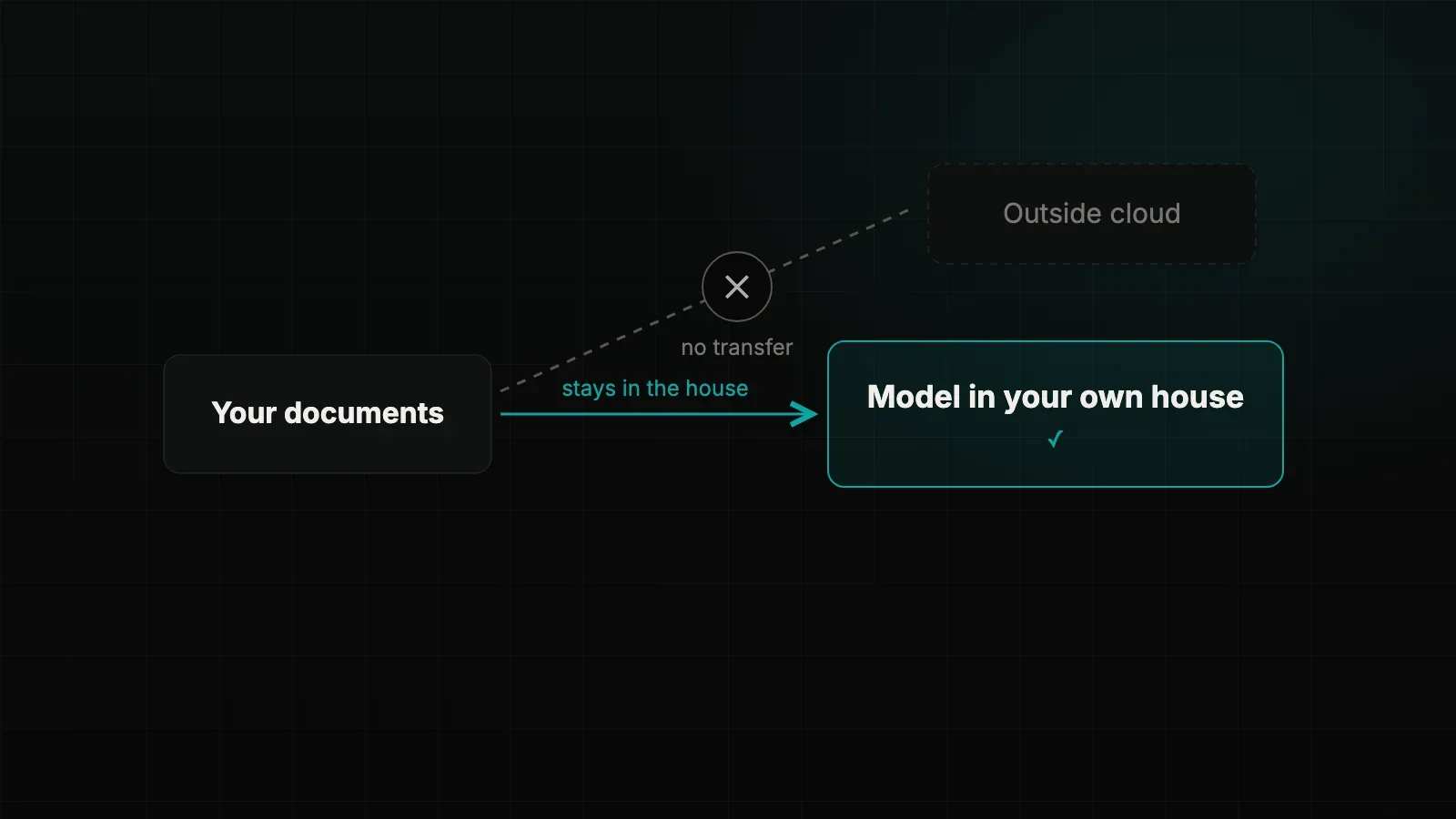
- Process locally. For anything genuinely sensitive, the most elegant answer is the shortest processing chain: an open model on your own hardware. No transfer, no third country, no DPA — because no third party is involved. What never leaves the house needs explaining to no one.
And day to day?
A one-page AI policy beats any ban: which tools are approved, which classes of data may go where, and whom to ask. Add a short training session — which the AI Act requires anyway — and the topic loses its terror. In AI use, data protection is not an obstacle; it is a selection criterion. And as with choosing a provider: the less you hand over, the less you have to explain.