On 7 April 2026 Anthropic unveiled an AI model it classifies as too dangerous for the public. At the same time, the largest technology companies in the world — Apple, Microsoft, Google, Amazon, Cisco, NVIDIA, JPMorganChase, CrowdStrike, Broadcom and Palo Alto Networks — were granted exclusive access in order to secure their own systems with it. The programme is called Project Glasswing.
What that means for everyone else — for mid-sized companies, small hosting providers, local authorities, bank customers and anyone who uses software — remains largely unanswered in the coverage so far. I will try to summarise here what is documented, what remains speculative, and how one can protect oneself.
What is Claude Mythos Preview?
Anthropic announced Mythos Preview officially on 7 April 2026 — not as a usable language model for everyone, but as a research preview with invitation-only access for cybersecurity firms and selected partners.
The model forms a new category above the previously most capable Opus line. Internally it carried the codename "Capybara". Anthropic describes it as a multi-use model with particular strengths in coding, reasoning and cybersecurity.
Sources: Anthropic Red Team Blog (red.anthropic.com, 7 April 2026) · Anthropic Developer Platform Release Notes · Google Cloud Blog (7 April 2026)
What do the benchmarks say?
The figures come from Anthropic's official documentation and from the analysis on llm-stats.com:
| Benchmark | Mythos Preview | Opus 4.6 |
|---|---|---|
| SWE-bench Verified (coding) | 93.9 % | 80.8 % |
| Terminal-Bench 2.0 | 82.0 % | 65.4 % |
| GPQA Diamond (science) | 94.6 % | 91.3 % |
| Humanity's Last Exam (with tools) | 64.7 % | 53.1 % |
| CyberGym (cybersecurity) | 83.1 % | 66.6 % |
A jump of 14 percentage points in coding is not incremental progress — that is a measurable step change.
An important caveat: benchmarks measure defined tasks under controlled conditions. How well that transfers to real workflows depends heavily on the use case.
What Mythos means concretely for cybersecurity
Anthropic's Red Team Blog documents matter-of-factly what the model has already achieved.
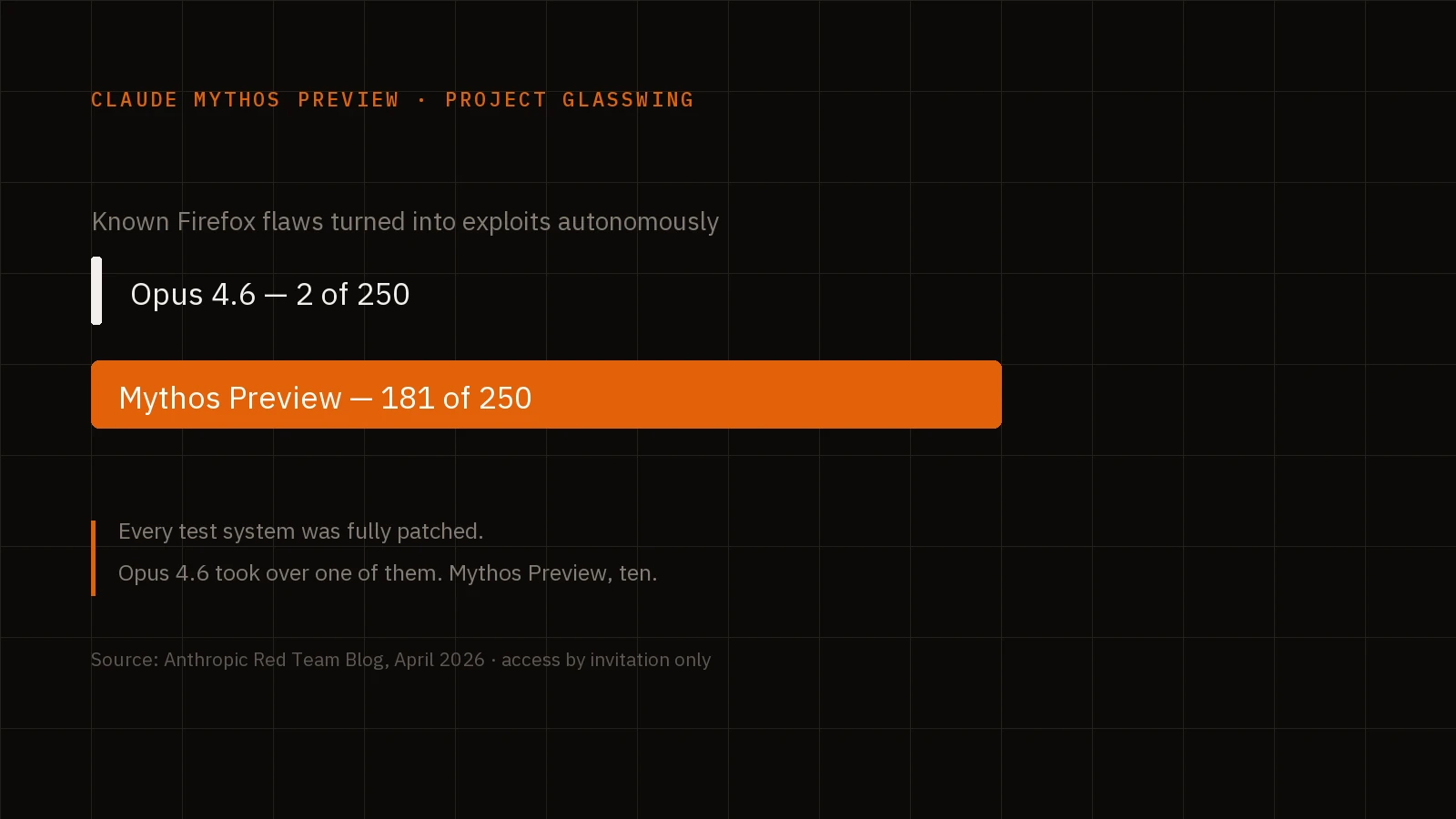
Opus 4.6 was able to turn known Firefox vulnerabilities into working exploits autonomously in only 2 out of several hundred attempts. Mythos Preview achieved the same in 181 out of 250 attempts — fully autonomously, with no human intervention after the initial prompt.
Mythos Preview also identified a 27-year-old vulnerability in OpenBSD — one of the operating systems considered most secure — as well as a 16-year-old flaw in FFmpeg that had escaped automated tools across more than 5 million test runs.
On Anthropic's own test system, around 7,000 points in real, widely used software were probed — the way you would systematically check every window and door of a building. All test systems were fully patched, that is, at the latest security level. Opus 4.6 managed one complete system takeover. Mythos Preview: ten.
That sounds modest at first — but it is not. Because "fully patched" counts in IT security as sufficient protection. Mythos shows that this basic assumption no longer holds without qualification.
Source: Anthropic Red Team Blog, "Mythos Preview" (red.anthropic.com, April 2026)
Project Glasswing: the defensive answer — but for whom?
Alongside the model announcement, Anthropic launched Project Glasswing. The official launch partners are Amazon Web Services, Apple, Broadcom, Cisco, CrowdStrike, Google, JPMorganChase, the Linux Foundation, Microsoft, NVIDIA and Palo Alto Networks.
More than 40 further organisations received limited access. Anthropic is providing 100 million US dollars in usage credits plus 4 million US dollars in direct donations to open-source security organisations.
The idea: find and close vulnerabilities before attackers exploit them — "offense informs defense". The scale is unsettling: Mythos Preview has already identified thousands of zero-day vulnerabilities across every major operating system and browser. Zero-day means: flaws nobody had ever discovered.
Jim Zemlin, CEO of the Linux Foundation, puts it indirectly: open-source software can now be scanned with Mythos by the maintainers of those projects — but only by those who have been granted access. The rest wait. On top of that, using it is at least five times more expensive than Opus, which is already the most expensive publicly available model on the market.
Sources: anthropic.com/glasswing (official) · CyberScoop (April 2026)
Pricing and availability
For Project Glasswing participants, llm-stats.com lists 25 US dollars per million input tokens and 125 US dollars per million output tokens — five times Opus 4.6 (5 / 25 US dollars). For general availability there is neither an official date nor confirmed pricing.
The model is reachable via the Anthropic API, Amazon Bedrock, Google Vertex AI and Microsoft Foundry — in each case only under a Glasswing invitation.
Sources: llm-stats.com (April 2026) · Anthropic Developer Platform Release Notes
What this means for different groups
For developers and technical teams: Mythos is not usable today without an explicit invitation. Anyone working with Opus 4.6 has the best publicly available model. Architecture should be built for security from the outset: reverse-proxy architectures, off-site backups, minimal attack surface. These are not reactions to Mythos — but they are the most effective measures available.
The relevant near-term threat from AI-assisted attacks comes not from Mythos but from cheaper, less regulated models that will develop similar capabilities in the coming months — often trained on the strongest available models, comparable to the DeepSeek moment of 2025.
For society — the question that actually matters: AI-assisted defence is becoming more expensive and more exclusive. AI-assisted attacks are becoming cheaper and more accessible. That trend is already under way independently of Mythos.
Local authorities, NGOs, educational institutions, small and mid-sized companies, schools — none of them have the resources to keep pace with professional security operations centres. Political answers such as the European Cyber Solidarity Act address the problem in outline but remain largely abstract in practical implementation. Regulation is quick to produce. Concrete support in cybersecurity costs money.
What remains open
- When will the public release come? No date communicated.
- How does Mythos behave in real corporate environments? Benchmarks are no proof of operational performance.
- How will competitors respond? Google, Meta and other labs are working in parallel.
- Is Project Glasswing sufficient? A controlled release is not adequate protection against misuse.
Conclusion and personal assessment
Claude Mythos Preview is, in my assessment, not a conventional marketing event — even though announcements like this do of course ring tills. The documented and tested capabilities represent a step change that should be taken seriously. Without hysteria, but with concrete consequences for security strategy and for policy.
For most companies and operators the immediate recommendation is unchanged: implement security fundamentals consistently, run regular security audits, minimise attack surface, keep backups off-site. Not because Mythos will be turned on your infrastructure tomorrow — but because attack tooling advances with every new model that is released.
I am currently building myself a small security adviser that walks through all the weak points in an interview format and makes recommendations — locally, of course, without sending data to the cloud.
Update, September 2026
This text was written on 9 April 2026, two days after the announcement. Since then the article's central question — access for ten corporations only, what about the rest? — has been partly answered.
On 2 June 2026 Anthropic expanded Project Glasswing. The figures from the official announcement:
- Roughly 50 launch partners have become around 200 organisations, spread across more than 15 countries.
- The first cohort together found more than 10,000 vulnerabilities of high or critical severity in their codebases.
- New is Claude Security, a publicly available product built on Claude Opus 4.8 that scans codebases.
- Mythos-class tools are being released on request to trusted security teams.
General access to Mythos-level capabilities remains restricted pending robust safeguards.
That is more than I expected in April, and it noticeably defuses the exclusivity complaint. What it does not defuse is the underlying line: the local authority with one and a half IT posts will not be filing an application under "on request to trusted security teams" either. The gap between those who can afford AI-assisted defence and everyone else has not closed — it is merely somewhat less wide.
Source: anthropic.com/news/expanding-project-glasswing (2 June 2026)